


Black Holes, deep Focus and Why Being Interrupted Hurts
News posted: 16 March, 2026 Post by: Emily Edwards
Time to read: ~ minutes, give or take.
Listen to this blog post
When I close my eyes and think about what it’s like when my attention locks onto something, I don’t see a spotlight or a tunnel… For me, it’s a black hole. Huge. Powerful. Above me and to the right, somewhere out in the universe. And it’s pulling me in.
If you know anything about black holes, you’ll know that their gravitational pull is so strong that nothing escapes — not even light. That’s what my focus feels like when it takes hold.
It’s not a choice I make.
It’s a force.
Something catches my attention and the pull begins, and once it has me, everything else in the universe goes quiet.
If that sounds familiar — if you’ve ever been so absorbed in something that the world fell away completely — you might recognise yourself in what I’m about to describe.
There’s a Name for This: Monotropism
The theory of monotropism, first developed by Dinah Murray, Mike Lesser and Wenn Lawson in the 1990s, suggests that autistic people tend to focus their attention in a few intense streams rather than spreading it widely. Their later paper (Murray, Lesser & Lawson, 2005) connected this attentional style to many of the characteristics associated with autism.
Monotropism describes how many autistic and otherwise neurodivergent people tend to focus their attention:
Not spread wide across lots of things at once, but poured deeply into a one or a few powerful channels.
Most of the world is set up for people whose attention works like a wide-angle lens — taking in lots of things at a low level of intensity. Monotropic attention is more like a zoom lens. It focuses deeply on a few things at a time, bringing detail, richness and connection that can easily be missed when attention is spread too widely.
This isn’t a flaw. It’s a different way of attending to the world — one that can be incredibly rich, creative, and rewarding. But it’s rarely described that way. More often, what you hear is that your focus is ‘too rigid,’ your interests are ‘too narrow,’ or that you need to learn to be ‘more flexible.’
Nobody says that about a black hole. A black hole is one of the most powerful forces in the universe. It just operates by different rules.
This is what my attention looks like from the inside. I drew this during my own workplace coaching in 2022, long before I had a word for it.
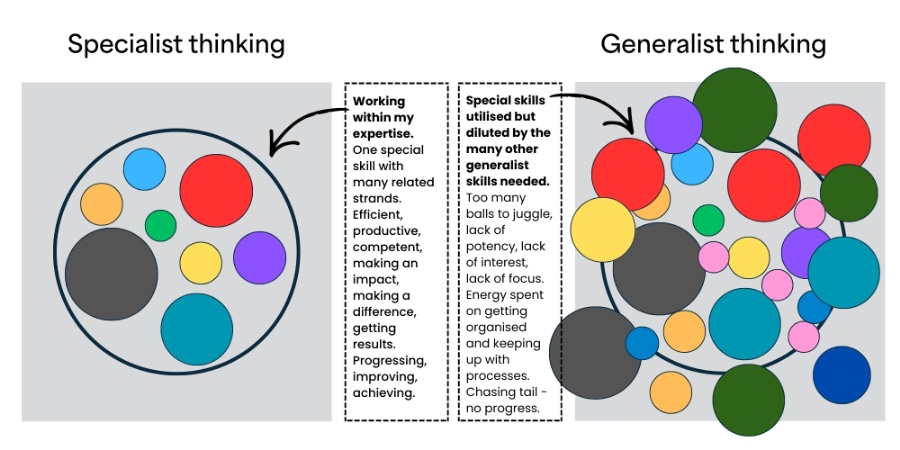
What I discovered through my coaching was that when my attention was allowed to go deep, my strengths could develop fully. Conversely, when work pulled my attention in many directions, those strengths became diluted.
The long-term impact of this for me in that role was frustration, increased masking and eventually burnout.
Looking back now, I can see that my attention was being constantly pulled into a more “generalist” way of working, when my natural way of thinking was far more specialist — something that the theory of monotropism helps to explain.
This insight was one of the key factors that ultimately led me to train as a coach — a role where those strands of experience and skill could finally come together in one place.
When There’s a Black Hole, Then What Happens?
I get pulled in, it's like flying.
Weightless.
Head first.
Zooming down into the black hole at incredible speed.
Whatever I'm focused on is sharp — vivid, detailed, almost hyper-real. But everything around it streaks into a blur, the way the roadside smears when you're driving fast and your eyes are locked on the road ahead. Pilots call it ground rush — that sensation of speed where your focal point is crystal clear but your peripheral world has dissolved into motion. That's what it's like inside my focus.
The thing I'm attending to has never been clearer. It's everything else that disappears.

And here’s the thing about real black holes: near them, time behaves differently.
Einstein showed that the stronger the gravitational field, the more time distorts. A clock near a black hole runs slower than a clock far away. Two people can experience completely different amounts of time passing, depending on where they’re standing.
That’s exactly what happens inside my focus. I can be zooming for hours, but it only feels like a few seconds. The experience of time genuinely changes. It’s not that I’m ignoring the clock — it’s that I’m in a different gravitational field from everyone around me. When someone calls me for dinner and I say 'I'll be there in a minute,' I mean it. It's just that a minute inside the black hole isn't the same as a minute outside it.
One of my clients described this perfectly:
"Time goes really fast — time passes and there's frustration, a feeling that I'm not improving."
When their attention locked on, everything else dropped away — including the clock. By the time they surfaced, hours had passed and other tasks had piled up. The frustration wasn't about the focus itself. It was about coming out the other side and realising the rest of the world had kept moving without them.
The Rocks I’d Never Noticed
Something happened recently that surprised me. I was exploring this black hole metaphor with a coach, using an approach called Clean Language (I’ll say more about that in a moment). I was describing the pull, the zooming, all the things I’ve just described to you — and then I noticed something I’d never noticed before.
Around the edge of the black hole, there were rocks. Particles. Floating. Almost suspended in space, not really moving.
After that session, my coach invited me look up black holes — to get to know more about those rocks and particles. This is a common part of working with Clean Language: the exploration doesn't stop when the session ends.
So I looked it up. And to my surprise, what I'd described from the inside is something astrophysics has already mapped from the outside.
Before matter gets pulled into a black hole, it often gathers in what’s called an accretion disk — a ring of material that orbits and accumulates around the edge. It’s the last zone before the event horizon, the point of no return. The material is already being pulled, but it hasn’t crossed over yet. It’s in between.
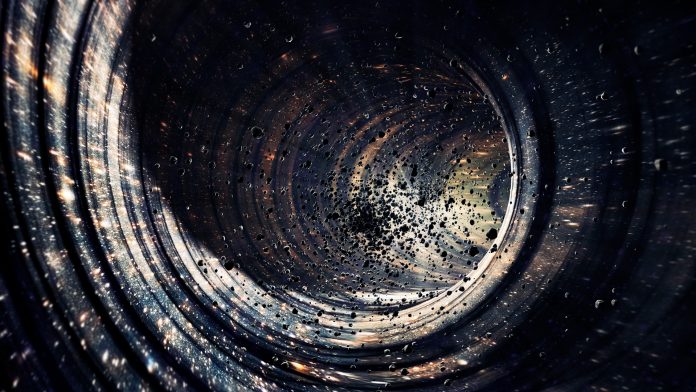
© iStock/gremlin
And when I thought about what those particles actually represent for me, it made even more sense. They're my ideas, my thoughts, the connections forming between things I've been reading, experiencing, doing, hearing from others. They all gather at the edge — and then we get pulled into the black hole together.
This is one of the things that never stops fascinating me about metaphor — it so often contains more information than you realise at the time. The logic was already there in my black hole. I just hadn't unpacked it yet.
That’s what those rocks were. They were the early warning signs that a black hole was forming — the signals before I get pulled in completely. And I’d never noticed them. I’d always skipped straight past them, straight into the zooming, and by the time I was in it, it was too late.
The fact that I discovered those rocks — that I could suddenly see something about my own experience that I’d missed for years — is a big part of why I’m writing this.
What Happens When Someone Pulls Me Out
In physics, the force near a black hole is so extreme that objects get stretched and pulled apart — a process with the wonderful name of spaghettification. The closer you are to the centre, the more violent the tidal forces become.
I think about this every time I’m interrupted mid-focus. Because being pulled out of my black hole doesn’t feel like a gentle tap on the shoulder. It feels like I'm being ripped. The force required is enormous, and for me it’s so physical it almost hurts. I feel it across my shoulders, my chest, my head. Instantly, there’s a surge of rage — a huge force of energy that builds up fast wanting to erupt.
And then I’m trying to hold it in. Trying to keep it at bay. But the pressure keeps building.
If you’ve ever snapped at someone who was just trying to tell you dinner was ready, or felt a wave of fury when your phone buzzed at the wrong moment, or found yourself shaking with frustration after being pulled away from something you were deep inside — this could explain it. It’s not rudeness. It’s not a lack of self-control. It’s how your attention works.
One of my clients put it like this:
"Stress spills over into family life. I get 'off' with my fiancé. I try to be relaxed and chilled, I get antsy, then I start forgetting stuff."
What they were noticing was the early signs of overload building. But the people around them didn’t see overload — they saw moodiness. For this person the guilt that followed could be worse than the reaction itself.
How I Discovered All This
Everything I’ve just described — the rocks, the transition time, what the energy needs — I didn’t figure out through willpower or self-help books or someone telling me what I should do differently. I discovered it through being asked very simple questions about my own experience.
The approach is called Clean Language. It was developed by a Counselling Psychologist called David Grove, and it works in a way that’s quite different from most coaching or therapy you might have come across. There are no leading questions. No advice. No ‘have you tried thinking about it this way?’ Instead, clean questions follow where your attention already is.
So when I said my focus was like a black hole, the question wasn’t ‘why do you think that is?’ or ‘how could you make it less intense?’ It was: ‘And what kind of black hole is that black hole?’
That question didn’t pull me out of my experience. It sent me deeper into it. And deeper within my own experience was exactly where my insights emerged from. The rocks were there all along — I just needed questions that let me look, rather than questions that told me where to look.
Rather than pulling someone away from their natural way of thinking, Clean questions work with monotropic attention — allowing people to follow the strands of their own experience until their own understanding emerges.
For a brain that works in deep, powerful channels of attention, this matters more than I can say. So much of the support available to neurodivergent people asks us to override our natural processing style — to think differently, attend differently, respond differently. Clean Language does the opposite. It treats your way of experiencing the world as the starting point, not the problem.
Why I’m Telling You This
Because if your brain works like a black hole, you’ve probably spent a lot of your life being told that’s a problem.
Too intense.
Too focused.
Too much.
Too hard to reach.
The rocks. The accretion disk. The transition time your energy has been asking for all along.
I know this because I’m in it. I’m neurodivergent. My brain is a black hole. And learning to explore that without judging myself — or apologising for it — has changed everything.
Further Reading
If you want to explore monotropism further, monotropism.org is the best place to start — it’s the main hub for the theory, maintained by Fergus Murray.
References
Murray, D., Lesser, M. & Lawson, W. (2005). Attention, monotropism and the diagnostic criteria for autism. Autism, 9(2), 139–156.
Comments are closed on this post.
#Clean Language #Clean Approach #Neurodiversity #Strengths-based approach #Coaching