


Where do I start?
News posted: 26 October, 2026 Post by: Emily Edwards
Time to read: ~ minutes, give or take.
Listen to this blog post
Where do I start? When something isn't working and you're wondering whether you might be neurodivergent
Sometimes the first thing a person notices is that something isn't working.
Work, home life, relationships or everyday routines may have become harder to manage. Or it may have been clear for a long time that some things use more energy than they seem to for other people, without it being clear why.



People reach the question 'where do I start?' by different routes.
- Some are wondering whether they might be neurodivergent, perhaps after reading, listening to or talking with neurodivergent people and recognising something of themselves in what they describe.
- Some are waiting for an assessment.
- Some have a diagnosis but are not sure it explains everything they experience.
- Others have known for years and have found that a change in their life, such as a new job, a house move, a change in family circumstances or menopause has made things that used to be manageable much harder.
Neurodivergence includes Autism, ADHD, dyslexia, dyspraxia, dyscalculia, Tourette's, acquired neurodiversity such as a brain injury, stroke, or something you don't yet have a name for.
Many of the people I work with also have a co-occurring long-term health conditions such as Ehlers-Danlos syndrome (EDS), fibromyalgia or postural orthostatic tachycardia syndrome (POTS).
There is a great deal of information available, but it can be hard to know where your own experience fits, especially if it looks different from what you read. Even when the information does fit, it can raise more questions than it answers:
- What is happening for me?
- What would help?
- How do I explain it to someone else when I'm not sure myself?
The questions people are asking
I recently went on a side quest and completed some exploratory research into the questions people ask in public forums and discussions about neurodiversity and support. I prioritised UK sources from the last three years and found a collection of key questions. This is a small sample, so it can't tell us how common any experience is. However, I think the questions themselves are still worth paying attention to.
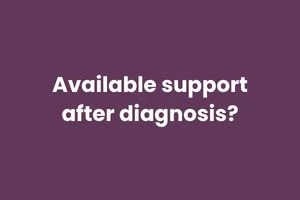
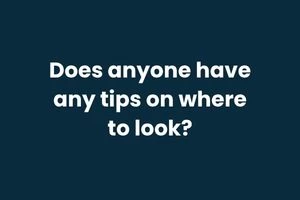
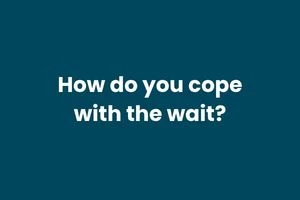
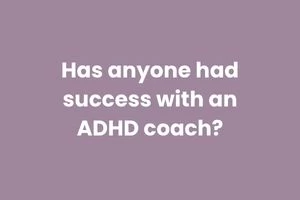
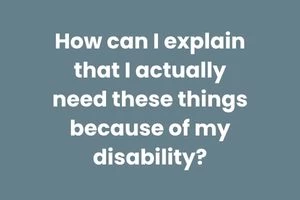
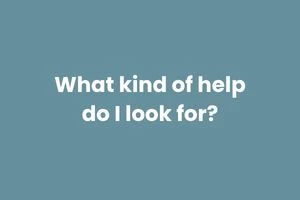
These 6 questions are what people actually asked.
My interpretation is that they cover different categories of experience:
- Diagnosis/self-identification
- Finding support
- Choosing the 'right' support
- Explaining your needs
Yet they are often treated as one question:
‘What support do you need?’
That question is hard to answer if you haven’t yet worked out what is happening for you and what might make a difference.
Where do I start? is a session for that earlier step. Before knowing what kind of support might work for you it can help to separate four things that are often discussed as if they were one.
-
A diagnosis or self-identification
 Recognising yourself in a particular kind of neurodivergence can explain a great deal. On its own, it doesn’t tell you what helps. Two people with the same diagnosis can need very different things.
-
Self-understanding
 Awareness of what makes things harder, what already works well and the conditions that enable you to be at your best. This is about how you work. It can be developed with or without a diagnosis.
-
Support
 This could be a peer group, books, podcasts, an advice service, coaching, therapy or workplace adjustments. Different kinds of support suit different needs and different people.
-
Practical changes
 Practical changes are what you, or other people, do differently day-to-day. This might be a change to a routine, a conversation with someone or an adjustment at work.
People can be at quite different points across these four

Someone with a diagnosis from many years ago may still be working out what helps.

Someone without a diagnosis, or who isn’t sure whether one would apply to them, may already know a lot about what they need.

If you are waiting for an assessment, what you learn about your own experience in the meantime is still useful, whatever the assessment concludes.
Looking for support is a task in itself
The Wiltshire Autism Hub is run by Wiltshire Service Users' Network and was shaped by local Autistic people. It describes several reasons Autistic adults in Wiltshire can find it hard to get support:
 Executive function
Identifying and seeking support can be overwhelming without help.
 Unknown, open-ended assessments
An initial assessment or interview with an unfamiliar format can be a barrier in itself.
 Needs that change
Support needs can change a great deal with circumstances and stress, so an assessment at one point in time may show very few needs and at another time, many.
These observations are about Autistic people in one county at one particular time. I don’t want to apply them to everyone, but they do connect with the questions above: working out what you need, researching the options and explaining yourself to someone new can be part of what is difficult in the first place.
Starting with understanding
In my work, I start with understanding rather than action. Two people might both describe themselves as overwhelmed, yet what leads to it, what they notice and what helps can be completely different. A diagnosis, or the absence of one, doesn’t answer those questions for an individual.
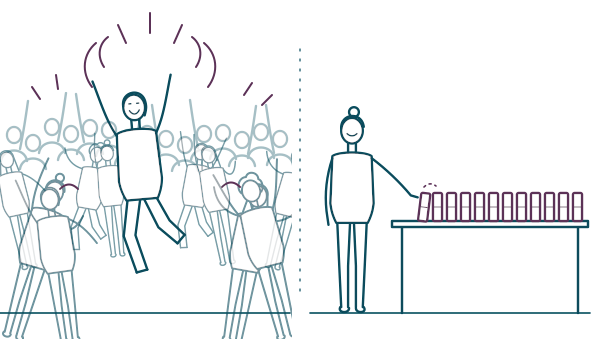
The same is true when things are going well. Asked ‘When you’re working at your best, you’re like what?’, my colleague and mentor Caitlin Walker described being in a mosh pit (left) and I described lining up dominoes (right). These are our own metaphors for how we each work best: one with lots happening at once, the other with everything in place before beginning.
Sometimes it helps to begin with the times when things go more easily, even a little:
- What is different about them?
- Where are you?
- Who is there?
- What are you doing?
For some people, there aren’t many times like that right now. That’s fine. What happens when things are difficult can hold just as much information about what you need.
Understanding doesn’t have to be complete before anything else happens. Sometimes it leads to something practical: a conversation with a manager, an adjustment, trying a different kind of support, deciding whether to seek an assessment or deciding to wait. Sometimes it gives you clearer words for your experience, which can make the question ‘what do you need?’ easier to answer when someone asks it.
Where do I start? A new pilot session
Where do I start? is for adults who are questioning whether they might be neurodivergent, or exploring what being neurodivergent means for them. You might have a diagnosis, be waiting for an assessment, be unsure whether to seek one or have no particular label in mind at all.
At a glance
- One 90-minute conversation with me, online via Zoom
- You don’t need a diagnosis or a goal
- I’ll ask about what’s working well, what isn’t working so well, what you’d like to have happen and what you want to avoid
- With your permission, I record and transcribe the session using Otter, so I can give you my full attention
- Within a week, you’ll receive a written summary of what you’ve come to understand, what you know now and any next steps you’ve identified
- It isn’t a diagnostic assessment, therapy or advice
Join the pilot
I’m inviting 6 people to take part. The session costs £50. In return, I’ll ask for your feedback on what was useful and what should change. Bookings close for this pilot on 30 November 2026.
You don’t need to know what you need before you start. Working that out can be where you start.
Comments are closed on this post.